Come the last few months of the year, weight loss and diet top the New Year resolution for many and are the most-searched topics on the Internet. But losing weight is a tough journey that needs utmost discipline with the ability to say no to your favourite food. It takes months, if not years, of dedication to reach the desired result. And if you are part of the police force, then staying fit becomes the mantra of your life.
Here is an inspiring story of Shrishail Byakod, a 38-year-old circle police inspector attached to the Ghataprabha police station in Belagavi’s Gokak taluk, who became the first Man in Khaki from Karnataka to win a Half Ironman Triathlon event. A Half Ironman is just over double the distance of an Olympic distance triathlon and includes a 1.9 km swim, 90-km cycling and 21.1 km of running.
But success didn’t come to Shrishail on a silver platter as his body weight acted as a barrier.After clocking 102 kg on the weighing scale in 2014, he realised the importance of health and then began his fitness journey. It was during the same time that a few of his well-wishers, including his wife Smita, advised him to practice a healthy life. He initially started dieting and later joined a gym and gradually started running, swimming, cycling and playing lawn tennis.
In the Half Ironman Triathlon competition held in Kolhapur on October 1, Shrishail was set a deadline to complete swimming, cycling, and running under 10 hours. But he completed them all in just 6 hours and 39 minutes. He swam 1.9 km in 52 min 48 sec, 90 km of cycling in 2 hours 57 minutes and 21 km of running in 2 hours and 28 minutes, and entered the Forever Star Book of World Records.
“From 102 kg in 2014, I dropped to 96 kg in 2019 and now I am 75 kg. It is not any magic. I just followed a healthy lifestyle. It happened only when I realised nothing is more important than health when I was 35,” he told The New Sunday Express.
Shrishail says that each day he sets aside 3-4 hours for his fitness. Twice a week he concentrates on swimming, while two days each for cycling and running. He has been following a strict diet under the guidance of his wife, which includes food with less oil, green vegetables, fruits, and oats.
He says, “I want to say that everyone should give more importance to health than money. If you are fit, then you will have everything. Each person should and must contribute time for his or her physical fitness.”
Shrishail says the Half Iron Triathlon in Kolhapur was the first competition he ever participated in and he is happy to fetch a gold medal. He says he knew that he needed a lot of stamina for the competition and he concentrated on playing tennis which boosts stamina, he said.
Shrishail is the first Karnataka police personnel to win the gold in the competition. Now, he is planning to participate in the international Iron Man to be held in Kazakhstan in August 2023. Shrishail, who received the Chief Minister’s Medal for his service in 2019, has been creating awareness on the importance of health and fitness. Because of his efforts, even the other police staff at Ghataprabha police station have started seriously concentrating on fitness.
Karnataka Bank MD Mahabaleshwar Bhat who wrote a new chapter in the banking sector has been selected for the prestigious Panchavarna Rajyotsava award. He will be conferred the award with a silver panel during the silver jubilee celebrations of Panchavarna Yuvaka Mandala under the title of Kannada Rajyotsava near Amrutheshwari temple, Kota on November 15 and 16.
He will be presented Panchavarna special award by Samradhi Mahila Mandala Cherkadi, Brahmavar, felicitations by Arjun Bhandarkar, head of Save Life Charitable Trust, Mangaluru and Niswartha Seva Trust, Kota and another award by Samradhi Kundapur, recipient of Drama Junior award.
Scholarships to Kannada medium school, monetary help to poor patients and uniforms to students will be distributed during the two day long programme, said the mandala president Amrath Jogi in the press release.
Hangyo Ice Creams Pvt Ltd was awarded as the Best Family Owned Business Award at India Family Business Summit 2022 organised by FICCI at FKCCI Bhavan here.
From Hangyo, Srinivas Pai and Sankeern Pai received the award from Murgesh Nirani, minister for L&M Industries, Ullas Kamath – president FICCI-Karnataka, and V B Gopal Reddy, president FKCCI.
After India’s financial capital of Mumbai, Karnataka’s capital city of Bengaluru became the second city in the country to have a 90-meter tall aerial ladder platform vehicle for the State’s Fire Services.
Chief Minister Basavaraj Bommai, who dedicated the aerial ladder platform vehicle in Bengaluru on Thursday, said: “Today marks an important day for the development of Bengaluru as well as infusing a biggest strength for the Department of Fire Services.’’
The Chief Minister also flagged off “Green Deepavali,’’ a public awareness campaign on the stairs of Vidhana Soudha.
The 90 meter aerial ladder platform is a most essential and important facility and this modern ladder will work as a real friend in need,’’ he said adding: The new ladder will be put into use in BBMP limits.
“The whole world is growing on a big scale and it is a most essential service especially in all important metropolitans without which building permission is not given.,’’ Bommai said.
The Chief Minister said Fire Safety and its rules are equally important. It was essential for the Department of Fire and Emergency Services to have all facilities to reach hi-rise buildings during an emergency.
Ready to Serve
The State Government is capable of solving problems, he said pointed out that Bengaluru City is growing fast and several definitions are made without understanding issues.
“The recent rains had created floods only in two constituencies and not in all 26 Assembly segments. But it was projected as if the whole Bengaluru City had submerged. In fact, Bengaluru is an important city both in national and international level and the government is capable of solving any problems of the city. It is important to present facts correctly,’’ he said.
Bommai said there are over 100 personnel working in SDRF to deal with flood situations. The State Capital has both NDRF and SDRF teams and they are capable of rescuing anyone from any part of the city.
The government had already released Rs 20 crore to buy the new equipment and another Rs 20 crore was released recently. The governments intention is o strengthen SDRF.
Instructions are given to form another two companies of SDRF for which ex-servicemen will be appointed. Already, over 100 retired defense personnel were appointed and more personnel will be recruited directly for the proposed two companies, he said. Along with modernisation and increasing numbers, even training and empowerment are also given importance. The SDRF had helped during the recent floods in different districts, he added.
The Chief Minster said till now the Bengaluru Fire Department had only a 50 meter ladder and the State capital is growing fast both horizontally and vertically. “After Mumbai City, Bengaluru has become the second city in the whole country to have a 90 meter Aerial Ladder Platform system. Efforts were made to procure this in the last two and a half years and while he was the Home Minister the grants had been released. But it got delayed due to some reasons such as Covid-19 and production problems,’’ he said.
Bommai said permission has been given to strengthen the Department of Fire Services by sanctioning various schemes and one of them was the procurement of 90 meter aerial ladder platform.
This department rescues people in any fire mishap that occurs in any corner of the city all the 24 hours, he said.
The Chief Minster said 5,000 new vehicles are added to the fleet of vehicles daily whereas the roads have remained the same. Despite this, the police department has been managing traffic by using several technologies including synchronizing for free flow of traffic.
“I will compliment Home Minister Araga Jnanendra, Home Department and senior officials of Department of Fire Services for bringing this ladder to Bengaluru,’’ he said.
Potholes being filled up:
Steps are taken to fill up potholes across the city. New potholes have emerged due to incessant rain. Even they too are being filled up on the war-footing. It was possible to do quality works in case rain reduces. Whatever repair works done would not last long during continuous rain. But all the potholes will be filled up, Bommai said. The Chief Minister wished the people on the occasion of Deepavali festival and asked them to celebrate by using green crackers. The citizens must use the crackers of less than 125 decibels.
Earlier, the Chief Minister went in the newly dedicated aerial ladder platform along with others.
Asked about his experience, Bommai said: “I was surprised to see the design of Vidhana Soudha dome. In those days, they had taken this stone to the top of the building. I was elated to see the Ashoka Pillar from a close angle. The solace is that with the new ladder it is possible to save lives of people in fire mishaps.
As many as 7500 cameras are installed under the Nirbhaya scheme and it will be used to address the problems of traffic density and for women safety. They work on artificial intelligence and revolves 360 degree.
Home Minister Araga Jnanendra, Ministers Kota Srinivasa Pujari, S T Somashekar, Shivaram Hebbar, MP P C Mohan, MLA Niranjan Kumar, Additional Chief Secretary (Home Department) Rajneesh Goel and DGP (Fire Services) A K Pandey were present.
In a function held at New Delhi on October 18, Karnataka Bank is awarded with the prestigious National Digital Transformation Awards ‘DX 2022 Awards’ conferred by Confederation of Indian Industry [CII] for Best Practice in Digital Transformation under BFSI segment in recognition of the “Innovative Excellence” in three categories viz. ‘KBL HR NxT – Employee Engagement’, ‘KBL Operations NxT – Operational Excellence’ and ‘KBL Customer NxT – Customer Experience’.
Expressing his satisfaction, Mahabaleshwara M.S, MD & CEO, said “the wholistic transformation journey ‘KBL VIKAAS’, launched by the Bank in the year 2017, has built a strong foundation for digital transformation. As digital is the way forward, under wave 2.0 of ‘KBL VIKAAS’, Bank has placed digital banking on fast forward mode and ‘KBL NxT’ concept was launched in the year 2021 with an objective to eventually emerge as the ‘Digital Bank of Future’ ”. In ‘KBL NxT’ journey, Bank is focusing on digitization under various verticals viz. Customer Experience, Operations, Human Resources, Technology, Cyber Security, Digital Marketing, Partnerships etc. and digital transformation has started paying huge dividend to the Bank. It will continue to be a win-win situation both for customer and the Bank. In this connection, I also laud the efforts of IT and Transformation Teams of the Bank”
Prime Minister Narendra Modi unveiled HTT-40, the indigenous trainer aircraft designed and developed by Hindustan Aeronautics Limited (HAL) at the India Pavilion during DefExpo-2020 in Gandhinagar, on Wednesday.
The Basic Trainer Aircraft would be used for basic flight training, aerobatics, instrument flying and close formation flights, whereas its secondary roles would include navigation and night flying. HTT-40 has cutting-edge technology designed to meet primary training requirements of the Indian defence services. Built around a meticulouslytested, turbo-prop engine, it is equipped with the latest avionics, an air-conditioned cabin and ejection seats. HTT-40 boasts of unique features like running changeover of pilots, hot-refuelling and short turnaround time.
HAL receives DcPP certificate
Hal also received a Deve lopment – cum -Production Partner (DcPP)/Production Agency (PA) certificate for ABHYAS – High Speed Expendable Aerial Target (HEAT) System from DRDO at a programme held on the sidelines of DefExpo-2022. The Aircraft Division of HAL is the first DcPP/PA identified organisation under ADE-DRDO’s new scheme for the procurement of a complex system. HAL had formally handed over the first batch of two units of High-Speed Expendable Aerial Target (HEAT) System ABHYAS, an indigenous target aircraft, to Aeronautical Development Establishment (ADE) recently. HAL CMD CB Ananthakrishnan received the certificate from DRDO Chairman and secretary of the Department o f De f enc e R&D Dr Samir V Kamat
Congress veteran Mallikarjun Kharge became the first non-Gandhi President after 24 years by defeating his opponent Lok Sabha MP Shashi Tharoor by a margin of over 6,000 votes.
Out of the 9,385 votes polled in the Congress presidential polls, Mallikarjun Kharge got 7,897 votes, Shashi Tharoor secured 1,072 votes, and 416 votes were declared invalid, the party’s Central Election Authority (CEA) chairman Madhusudan Mistry said.
Kharge won with eight times more votes.
Soon after the election results were announced, Tharoor congratulated Kharge in a letter and termed the election as a ‘true celebration of inner-party democracy.’ “The revival of the party has begun today,” Tharoor said.
Kharge will replace Sonia Gandhi, the longest-serving party president who has been at the helm since 1998, barring the two years between 2017 and 2019 when Rahul Gandhi had taken over.
With no Gandhi family members in the fray, the election came three years after Rahul Gandhi resigned from the top post citing the Lok Sabha poll debacle in 2019.
Kharge will take charge on October 26.
MP Rahul Gandhi on Wednesday said the president was the ‘supreme authority’ in the Congress and whoever got elected to the post would decide on the way forward (for the party). “President is the supreme authority in the Congress and everyone reports to him. My role – I am very clear – Congress president will decide what my role is and how I will be deployed,” he remarked as Bharat Jodo Yatra entered Andhra Pradesh.
Congress central election authority chairman Mistry on Monday expressed satisfaction with the party’s presidential polls process, saying it was “free, fair and transparent”. He also said it was a secret ballot and no one would get to know who voted for whom.
The election is significant for the party as an internal election to the top post is taking place after nearly two decades.
The last election for the post of Congress chief was held in 2000 when Sonia Gandhi defeated her opponent Jitendra Prasada by an overwhelming majority.
Meanwhile, congratulations poured in for Kharge from many senior leaders and celebrations erupted outside AICC headquarters in the capital.
Earlier in the day, after the counting of votes began, the Tharoor camp alleged extremely serious irregularities in the poll process.
In a letter to CEC Madhusudan Mistry, Tharoor’s campaign team member Salman Soz said, “The facts are damning and the election process in UP is devoid of credibility and integrity.”
He also alleged the use of unofficial seals for ballot boxes and the presence of unofficial persons in polling booths.
Later in a tweet, Soz said that the CEA has assured fair inquiry into the allegations. “After discussions with CEA, we have agreed for the counting to continue and our team looks forward to the results,” he tweeted.
However, in reply to media queries, Mistry said that the CEC has prepared a point-by-point reply to the complaints raised by the Tharoor camp. He also said that the letter shouldn’t have been made available to the public.
Even during the campaign, Tharoor raised allegations of preferential treatment by his senior colleagues several times and approached the CEA on the same.
80-year-old Kharge with more than 50 years of experience in politics was largely seen as the candidate backed by the top leadership in the Presidential election. While Tharoor rooted for reforms in the party, Kharge promised to follow the Udaipur Chintan Shivir resolutions to bring changes in the party.
Kharge, a senior Rajya Sabha MP from Karnataka, is seen as a hardcore loyalist of the Gandhi family. He resigned as the leader of the Opposition in Rajya Sabha, on October 1, 2022, to contest for the President post of Congress.
Though many senior leaders hailed the election as the beginning of inner party democracy, they also expressed apprehension about the elections to the Congress Working Committee (CWC) and cast doubts that the President would act as a rubber stamp. The immediate challenge for Kharge will be the performance of the party in the upcoming Assembly elections in Himachal Pradesh and Gujarat, said a leader
Of the total 9,915 Pradesh Congress Committee (PCC) delegates that formed the electoral college to pick the party chief in a secret ballot, over 9,500 cast their ballot at PCC offices and the AICC headquarters, Mistry had said at a press conference after the polling ended on Monday.
Electors in the Congress presidential polls had been asked to put a tick mark against their candidate in the ballot paper after Tharoor’s team took up with the party’s top poll body the issue of its earlier directive that voters write “1” to reflect their preference. This, the team said, might lead to confusion.
Ahead of the polling, Kharge had said he would have no shame in taking the advice and support of the Gandhi family in running the party affairs, if he becomes its president. Tharoor, meanwhile, said that some colleagues were telling party workers that they know who Sonia Gandhi wants elected”.
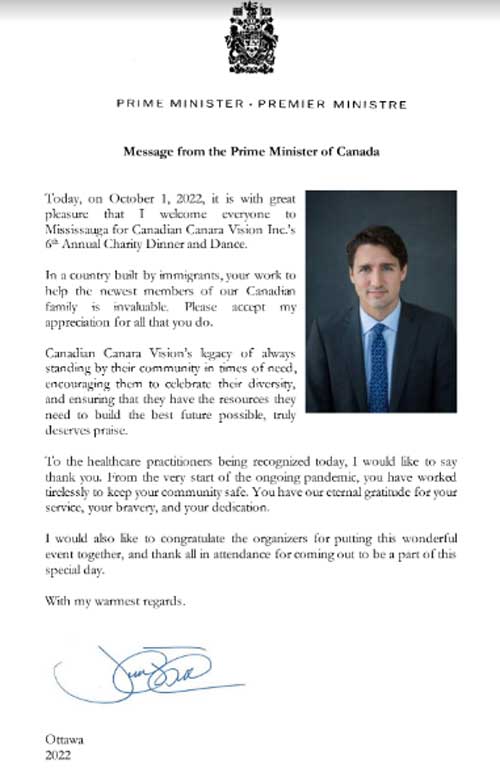
Perhaps October 1, 2022, turned out to be a red-letter-day for the Mangalurean community in Canada when Canada’s Prime Minister thanked Dr Dorothy Rego BSc, MSc, PhD, MPH in his letter and when she received a prestigious Yeomen Service Award 2022 from the Canadian Canara Vision Inc (CCVI) in recognition of her remarkable contribution in the field of Scientific Research, Public Health and Social Science in India, Africa, and Canada.
Dr Dorothy Rego, an immunologist, microbiologist, and public health professional has worked in the field of science for over 15 years. Enormously passionate about science, Dr Rego is especially committed to focusing on the needs and health of others and the most vulnerable.
Message from Prime Minister of Canada
Originally from Gurpur-Kaikamba in the suburbs of Mangaluru, she currently resides in Brampton with her husband, Ronald Rego and two children, Seneca and Roysten. She completed her Bachelor of Science in Botany, Zoology and Chemistry from St Agnes College, Mangaluru in 1991 and Master of Science in Microbiology from Kasturba Medical College, Mangaluru in 1994. Dorothy also successfully completed her Master’s cum Doctorate (PhD) in Microbiology/Immunology from the University of Ottawa in 2008 and MPH (Master of Public Health) from the University of Guelph in 2017.
Dr Rego’s areas of expertise includes disease surveillance, vaccine implementation, gender equality, tobacco control, women’s empowerment, maternal child health, cancer research, HIV prevention, food fortification, anaemia reduction and more recently, the COVID-19 pandemic. She has 7 peer reviewed publications in highly influential American, British, and Indian journals and an impressive 5 scientific reports and 21abstracts published to add to her already remarkable portfolio. As a scientific researcher, she has worked for Health Canada, Peel Public Health, Global Affairs of Canada, and the Gates Foundation.
Dr Rego was part of the leadership team of Peel Public Health’s response to COVID-19 pandemic. She played a crucial role in conducting high quality synthesis of evidence which focused on reviewing the existing evidence and disseminating the evidence to decision makers in the implementation of public health interventions and policies.
Pre-pandemic, Dr Rego worked with WHO (World Health Organization) where she conducted a comprehensive review addressing policy recommendations for anaemia reduction strategies among women of reproduction age in low- and middle-income countries at a global level. Deployed to Africa for HIV work, she took great pride in working closely with the Kenyan Ministry of Health in implementing HIV self testing program among homosexual men to enhance timely diagnosis of HIV and linkage to care.
Prior to her migration to Canada, Dr Rego worked for reputed institutions in India such as CMC Vellore and JIPMER Hospital in Puducherry. Her work with children under 10yrs for a vaccine implementation study at JIPMER Hospital was the impetus for her increasing passion in public health.
An amazing and highly intellectual personality like Dr Dorothy Rego does not need any further introduction. After the Award ceremony, I had the unique opportunity to toss a few questions at her as the representative of Daijiworld.com.
Excerpts from the interview:
Q. On behalf of Daijiworld.com, I am privileged to interact with you. Tell me how it feels to bag a prestigious Award from a renowned non-profit organization like CCVI for your remarkable contribution to the field of Scientific Research, Public Health, and Social Science.
A. First and the foremost, I thank God for blessing me with wisdom, humility, and grace. These blessings have enabled me to scale mountains and face challenges. I also thank the CCVI for recognizing my work and bestowing me with the Yeomen Service Award. I am humbled and deeply appreciative of this prestigious award. I admit that my contributions to the field of Scientific Research, Public health and Social Science are still on a small scale; however, I view the award as a way forward to do and be more. This recognition has spurred and inspired me to learn and implement more in my fields of expertise.
Q. Can you please tell us something about your parents, siblings, and your childhood days in the picturesque town Gurpur-Kaikamba in Mangaluru, India?
A. I was raised by my father, late Dominic R J D’Lima. My grandmother, late Lucy D’Lima along with my paternal aunt, Leena D’Lima gave me an amazing childhood. I have only one younger sibling, Don John D’Lima who is an Advocate in Mumbai. My weekend nature walks in the lush greenery of Kaikamba along with my dad in the picturesque Gurpur aroused my curiosity about all things related to science. I still cherish the joys of playing some country games like lagory, kutti donne, jibli and mane aata along with 4 other kids in the neighborhood. It was an unforgettable childhood filled with setbacks, love, adventure, mystery, tragedy, loss, and joy.
Q. Can you please tell us something about your early schooling?
A. My journey into my professional development began from the century old Pompei higher primary school in Gurpur under the leadership of the late Sr Patricia. With great pride, I say that I learnt my first alphabets in this Kannada medium school. With immense gratitude, I mention that Sr.Laetita Bath from the Bethany congregation held my tiny hand and hovered it around the cement doodle to make the correct impression of my first Kannada alphabet. My heartfelt appreciation to Sr.Laetita Bath for her dedication and patience. From 1976 to 1983, I made a lifetime of memories from throwing stones at mango trees, picking Sapodilla aka chikoo’s during recess, chasing snakes in the lush green landscape, drawing well water using a bucket and rope to care for school garden and shedding tears to ‘Punya Koti’ narrative by Lucy teacher. An even more historic memory was walking as a class to meet Mother Teresa at Rosa Mystica grounds in 1980. I was awed by that meeting and inspired by Mother Teresa’s selfless work to do the same in my capacity and give back to the community and people amongst who I grew up. Among all, I did not want to attend classes. My beloved Lucy teacher would narrate this well to the readers in this platform. My teachers (the two Jacintha’s, Lucy, Gracy, Jerry, Jayanthi, Sr Jonett, Sr Shanthi, Sr Selma, the late Stella and Late Natalia,) put heart and soul in imbibing me with wisdom and knowledge. Even though this school’s structure was in a dilapidated condition in the mid 70’s, it did not deter me in carving a niche in building my career.
My next journey began in the Bethany run Rosa Mystica High School (RMHS) in Gurpur under the leadership of the late Sr Mediatrice. RMHS gave me an outstanding education with the best teachers, and they were: Sukanya, Leena, Agatha, Josephine, Yuvaraja, Sunder, Shabaraya, Felix, Shreedhar, Sr Wilma, Sr Helmina, Sr Afflicta, Sr Metilda, the late Sr Olivia and the late Sr Mediatrice. My science teachers inspired me with their extra ordinary teaching skills in Pythagoras Theorem derivation and taxonomical classifications which helped me to further refine my passion to progress in the field of biological sciences.
Q. Can you please tell me how your pre-university / university studies at India’s renowned St Agnes Institutions helped you to achieve the success that you are enjoying today?
A. In 1986, I entered the gates of St Agnes College as a PUC student in the science stream with absolutely zero English speaking skills. St Agnes College under the leadership of Sr Aloysius welcomed me with open arms, making me feel like her own as I came from a background different from most English-speaking students. St Agnes College was so open, welcoming, and reassuring that soon after my first term, I forgot about the past and plunged into new challenges. Over the next 5 years, I grew up intellectually both in wisdom and knowledge. I made friends who remain close to my heart today. I met teachers who shaped me in many ways, and as friendly and accommodating as they were, they always had best the interests for me. I bow with respect to all the signatures of my teachers (Maria, Noeline, Usha Nalini, Leela, Sr Beatrice, Saramma, Bhasker, Nagaveni, the late Kamala Devi, Sr Prem, Leo, Prema, Ronald, Saraswathi, and the late Mohan) imprinted on my lab records which I call my personal treasures. These lab records are maintained in mint condition in my ancestral home. The memories of my education such as the dissection tables of Zoology, the color reactions in chemistry labs, the Botany herbariums followed by robust record work where I tried to grab as many experiences and opportunities as I could are still fresh in my mind. The gallery style classrooms, where curriculum was intense, and marks were earned not handed out. It was here that I was introduced to the art and science of Biology which later metamorphosed me into a microbiologist, immunologist and public health professional with several degrees, awards, and accomplishments with exciting work experiences.
Q. Say something about your family and what motivated you to upgrade your educational credentials in Canada? Did you receive any inspiration from anyone or did anyone play a key role in your professional development?
A. My husband Ronald Rego migrated to Canada in 1996 from Dubai in search of greener pastures. I married Ronald in 1998 and joined him later that year in Canada. When we got married, it was my plan to upgrade my educational credentials. We are blessed with two children, 19-year-old daughter, Seneca and 16-year-old son, Roysten. Both children were born in Ottawa and these children were products of my graduate school in addition to my thesis. We currently reside in Brampton.
In my professional development, I credit my dad as being my single greatest influencer followed by my husband. They are both my heroes. My dad had only my best interest at heart. While growing up I had too many why questions to my dad, most of them were related to science. He was like an encyclopedia for me in an era when technology was absolutely zero. My dad reiterated to me several times what it meant to be a woman in the society and the vulnerability associated with being a woman. My dad insisted that women needed to be empowered with highest level education, dream an exciting career, and reach out to others.
My other hero stepped into my life after marriage but when I expressed my desire to upgrade my educational credentials, my husband whole heartedly not only encouraged and supported me but also accepted me as his student wife. He worked extremely hard to make ends meet while I took my backpack and went to the University as a student. In the late 90’s to early 00’s, there were not many options to specialize in public health in Canada, therefore I was left with specializing in basic sciences with an MSc/PhD in Microbiology/Immunology from the University of Ottawa. When Canada opened doors for public health in 2003 after the SARS crisis, I was already halfway through my MSc/PhD programme and I did not want to make a detour to public health. A few years later, it was a turning point in my life, which I call falling in love but with global public health. I decided to make 3-point turn into international public health and wanted another degree, Master’s in Public Health. When I expressed my desire, my husband whole heartedly supported me again. I became his student wife again in my mid 40’s. I am indebted to these two men and will forever be grateful to their selfless love and support.
Q. Because of your outstanding intellectual and service-oriented qualities, we look up to you as the most successful contributor in the field of Scientific Research, Public Health, and Social Science in India, Africa, and Canada. Could you tell us the secret behind your success?
A. This entire journey is akin to sailing through a storm and finally surviving the storm to reap the fruits in different continents. There have been turbulent times in this entire journey, but I persevered through all the challenges and triumphed. If I reflect on the journey, I can’t answer how I managed to endure and conquer. Sometimes, I worked too hard and sacrificed my sleep. There were times I stood up to myself to alter the challenges into enriching, rewarding and gratifying experiences. I always believed in myself and had immense confidence in my abilities. Overall, I was vibrant, full of energy, determined with a strong will power, courageous, focused, and confident. These qualities are the secrets behind my success.
Q. Dr Rego you were part of the leadership team of Canada’s Peel Public Health’s response to the COVID-19 pandemic. Could you please tell us what was your role in the implementation of public health interventions?
A. COVID-19 pandemic was a rapidly evolving science and the public health professionals must always be current with science to deliver best interventions for the betterment of the community. It was quite a challenge for us. In the first phase of the pandemic, my role included genomic surveillance to conduct a landscape analysis to identify the emerging variants of concerns circulating in the community. I worked extremely hard with 12-hour rotational shifts consistently to keep the Peel community safe. I quickly transitioned to Mass vaccination Program (MVP) in phase 2 of the pandemic. In MVP, I provided high quality synthesis of evidence which focused on reviewing the existing evidence and disseminating the evidence to decision makers in the implementation of public health interventions and policies. My efforts on identifying knowledge gaps in evidence led to the prioritization of COVID-19 vaccine to high-risk occupational groups in some settings in the Peel region. Also, I provided evidence-based guidance documents to the process management team which facilitated the smooth execution of mass vaccinations in the Peel region. In addition, I closely monitored the reported Adverse Effects Following Immunization (AEFI) that occurred from COVID-19 vaccination and reported these incidents to the regulatory bodies for further follow up.
Q: I learned from various media reports about your unique contribution to the field of Public Health and Social Science in India, Africa, and Canada. Can you please share some of them with a few details?
A. I will use one each example from India, Africa, and Canada to answer this question.
In 1995, I started a very challenging job at the JIPMER hospital in Puducherry, India. JIPMER is the pride of India. It is a government of India enterprise with a state-of-the-art facility and provides free health care. I was appointed to work with children under 10yrs for a vaccine implementation study in Pondicherry. It is so unfortunate that many of these kids in this coastal belt did not even live to celebrate their 10th birthday. They would succumb to some respiratory infections. Therefore, the goal was to visit the schools, collect throat swabs samples from kids to identify the culprit and then determine the next steps. My work began with calling out the tenders, purchases, school visits, sample collections, lab research and report writing. I saw high rates of vaccine preventable diseases among children, lack of advocacy among the public, low vaccine uptake and extreme poverty. This realization ignited a fire in me to give my best to the betterment of health through scientific research. My mentor, Dr Reba Kanungo did an excellent job of mentoring me from onboarding to recharging me whenever I was distracted and unfocused. Her motivational words included, “You are a perfect fit for public health, you work very well in the community, take it forward”. That is where it all began, the passion for public health. My pranam to Dr Kanungo, ‘Guru Devo Bhava’ – teacher is God.
In 2018, I was deployed to Africa. I took great pride in working closely with the Kenyan Ministry of Health in implementing HIV self testing program among homosexual men to enhance the timely diagnosis of HIV and linkage to care. This project was truly the best time of my life. My responsibilities were to assess implementation of HIV self-testing program among Men having Sex with Men (MSM) in Kenya. The stakeholders included MSM community, peer educators, outreach workers, health promoters, Kenyan Ministry of Health officials and scientists (infectious disease specialists, mathematical modelers, epidemiologists, and medical anthropologists). The key tasks were to perform an evidence review, administer focus group discussions and quantitative data collection in three counties called Kisumu, Kiambu and Mombasa in Kenya. This data was used in conducting a research design workshop in Nairobi, Kenya which highlighted the planning, organizing, designing, and delivering HIV self-testing program in Kenya. At the end of the research design workshop, I took the lead in the preparation of scientific reports, evidence briefs, research ethics submissions, grant application and a publication in British Medical Journal. It was a very time sensitive programme with numerous complex deliverables, but I was successful in meeting all the deliverables.
During pre-pandemic time, when I was working with Nutritional International in Ottawa, I had a stint with World Health Organization (WHO) in conducting a commissioned review. Our team addressed policy recommendations for anaemia reduction strategies among women of reproduction age in low- and middle-income countries around the world. This 78-page review included an emphasis on nutritional and non-nutritional causes and contributing factors for anaemia. I conducted a secondary data analysis on micronutrient supplements, iron deficiency, anti-natal care, iron folic acid supplements, dietary diversity, food security, deworming, access to water and sanitation to reduce transmission of helminthic infections and use of insecticide treated nets for malaria vector control using data from complex databases. My experience felt as if I was travelling through the 132 countries and conducting landscape analysis to summarize the key issues related to anemia. In this review, we addressed many gaps in and problems with anaemia reduction efforts, identified and described various components required for successful evidence-informed anaemia reduction programmes, and included recommendations for programme implementers and decision-makers, with links to multiple resources and tools that can be contextualized to each country’s situation. This work is published in WHO website. This is my biggest triumph in my contributions to public health.
Q. That’s incredible! Now you have achieved yet another milestone. The Prime Minister has a special mention of you in his letter to CCVI. If I’m correct you are the first Mangalurean to receive such an honor. Don’t you feel so proud to receive such recognition from the Prime Minister of Canada?
A. I was delighted to learn that our Prime Minister, Justin Trudeau, having learned of my enormous and valuable input into various areas of science has sent an eloquent and wonderfully written appreciation letter to me. This letter will always be treasured by me. A classmate who I am very close to and now residing south of the border joked, “I love your Prime Minister Trudeau but now I envy that you have his letter”. I am humbled to receive this letter of appreciation from our dear Prime Minister Trudeau. And this is yet another incentive to carry forward my plans and goals.
Q. What are your future plans in the sector of Scientific Research, Public Health, and Social Science?
A. I owe a great debt of gratitude to my roots and my birthplace. My childhood, hometown, the schools I attended nurtured me. These are my greatest treasures in life. As I said in the beginning, this award is a way forward. I am looking for avenues and opportunities to give back to the community such as implementing some public health programmes which can benefit the most vulnerable women and children in Mangaluru. My focus will be mostly concentrated on maternal child health. I am currently putting together the resources and doing the groundwork to bring on board the stakeholders to take a deep dive into the program. I want to leave a strong legacy behind. This is my dream, and I am excited to realize these dreams.
Q. What is your message to the younger generation, especially to our community youth?
A. I reiterate the same words of wisdom imparted to me by my dad. Empower yourself with highest level of education, harmonize your available resources, align your goals, build a network, envision an exciting career, and help others. Apart from your core skills, find a hobby or hobbies that motivate you and help you grow as these should be your natural therapeutic release. In my own life, gardening in the summer and cooking authentic Mangalurean food are my natural remedies to relieve my stress. In a nutshell – always dream high, stay ambitious, seek opportunities, work hard, do your due diligence, be honest, do not lose hope and always pray. When you excel in life, stay humble and down to earth, but don’t forget your roots. Give back to the community when you get an opportunity to do so. This is my message to the youth of our community.
Q. What is your message for the people of the west coast in India who are settled in Canada?
A. We should be thankful that we are living in a beautiful multicultural country called Canada. We, the people of the west coast of India, should take pride in keeping our mother tongue, heritage, tradition, and our culture alive. We all have inherited rich traditions that we grew up with, whether they are daily habits, festivities, music, sports, celebrations, or food. We must preserve our traditions by continuously practicing them in the country where we currently reside while adopting new traditions and habits.
A huge heartfelt thanks to you Gerry baab and to Daijiworld for giving me an opportunity to go down the memory.
The first round of the 2020 Indian National Rally Championship (INRC) held in Itanagar saw a young new talent blitzing her way through the competition to secure an overall top 10 finish on her debut. That day, motorsports veterans and enthusiasts felt that the newcomer was a future talent. Within just two years, they were proved right when Bengaluru’s Pragathi Gowda won the Asia-Pacific final of the FIA Rally Star programme held at the Madras International Circuit early last week, beating 26 other drivers, from seven different national motorsport clubs across the continent.
Gowda says she developed her interest in motorsports driving in the city, along with some big encouragement coming from her father and brother. Having to travel often for races, Gowda explains that coming back home helps her re-energise. “Bengaluru is such a wonderful place to live; I adore it! When I’m away, I genuinely miss the city, and I cannot wait to return home,” she says, adding that her favourite way to unwind is with a cup of coffee.
Having started her motorsports career very recently in 2019, Gowda says that getting an opportunity to represent India in an international event has been a dream come true. “I made my country proud with that win, and I will always cherish that achievement,” she says. After a impressive debut in INRC in 2020, she has emerged as one of the most promising racers in the country. However, she says that her experience in INRC was of little to no use during the Rally Star final.
“It was a completely different challenge. The car was radically different compared to the ones I’m used to. It was tricky to drive, as I had no prior experience with a rear-wheel-driven car. Adjusting to the car was a difficult process and it took me a while to get the best times out of it,” shares Gowda, who is self-taught. Despite her struggles to adjust to the car, she says that her comfort with gravel stages gave her the upper hand. “I’m a gravel girl, I always loved driving on dirt.
And I’m hoping that it’ll give me an advantage during the finals next year,” she quips. Despite her achievements, Gowda says the environment in Bengaluru and the wider region are not very supportive of motorsports aspirants. Drawing on her own experiences, she felt that most people view motorsports as dangerous, despite the recent advances in driver safety. “The negative perception acts as a barrier to entry, especially to women,” she says.
“If we had more top-tier international sporting events such as Formula 1, and World Rally Championship happening in the country, it would probably help change people’s perception, while giving motorsports wider exposure.” One day, she hopes to land a seat in the FIA World Rally Championship. And as she prepares for the all-important Rally Star finals in Peru next year, Gowda says the process hasn’t been straightforward as she lacks access to a suitable practice car.
“All this while, it was just me alone trying to make the country proud. But now, I’ll need the country’s help to give me the best possible chance at the next stage. I definitely cannot do it alone,” concludes Gowda.
International Master Athlete Vijaya Ramesh from Mysuru being conferred with State Award (Sports) by Chief Minister Basavaraj Bommai on the occasion of World Senior Citizens Day celebrations recently. IAS Officer N. Manjula is also seen.
The award carries a cash prize of Rs. 1 lakh.
Vijaya Ramesh has taken part in Hurdles, High Jump and Long Jump in Masters State, National and International level Tournaments apart from taking part in the World Championships.
She has represented India 16 times including 3 World Meets.
India First:
She has the credit of being the first woman to have won 14 medals abroad. President of Mysuru Masters Games Association and a Member of Rotary Club of Mysore East, she has been conferred with various awards including Kannada Rajyotsava Award.
Vijaya Ramesh, wife of ex-Serviceman Ramesh and a resident of Gokulam 3rd Stage in city, can be contacted on Mob: 98455-62413.